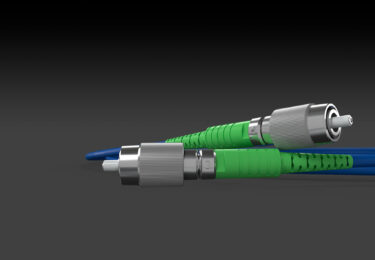
Photonic Crystal Fibers (PCFs) were first explored in 1996 by Philip Russell at the University of Bath, UK. These fibers typically consist of a solid or hollow core surrounded by a periodic array of air holes, which create a photonic bandgap effect that confines light within the core.
Since 1999, Hamamatsu Photonics has played a central role in the further development and commercialization of Photonic Crystal Fiber technology. We have been at the forefront of PCF innovation, developing various types of fibers, including large-mode-area fibers, hollow-core fibers, and nonlinear fibers.
Photonic Crystal Fiber Technology
Photonic Crystal Fiber (PCF) technology is a major breakthrough in how we design optical fibers, giving us incredible control over how light travels through them. Unlike regular fibers, PCFs have tiny air holes arranged along their length, which create a special effect that traps light inside the core. This unique setup lets us fine-tune light’s behavior in ways that open up all kinds of possibilities across many different fields.
At Hamamatsu Photonics, we have led PCF development, pioneering innovations that expand the capabilities of fiber optics. Our PCFs support single-mode operation over a broad wavelength range, ensuring high-quality signal transmission. Their versatility makes them ideal for applications requiring precise light control, such as fiber lasers, supercontinuum generation, and ultrafast pulse delivery.
PCF for Supercontinuum Laser Technology
Supercontinuum laser technology is a nonlinear optical process where a narrowband light pulse is transformed into a broad spectrum that spans from the ultraviolet to the infrared. This happens by launching high-peak-power femtosecond or picosecond pulses into a PCF, where nonlinear effects such as self-phase modulation, four-wave mixing, and soliton dynamics take place. These interactions cause the pulse to broaden spectrally, producing a smooth, continuous spectrum.
The unique properties of PCFs—like their engineered dispersion profiles and high nonlinearity—make them ideal for generating supercontinuum light. The ability to create a broad spectrum from a single source is invaluable in applications such as spectroscopy, imaging, and optical coherence tomography, where a wide range of wavelengths is essential for detailed analysis.
PCF for Single-frequency Laser Technology
Single-frequency lasers, known for their narrow linewidth and stable output, are essential for high-precision applications like quantum technologies, interferometry, and distributed acoustic sensing. Photonic Crystal Fibers (PCFs) improve these lasers’ performance by offering a stable, low-loss medium for light to travel through.
Thanks to their microstructured design, PCFs efficiently confine and guide light while minimizing nonlinear effects and preserving beam quality over long distances. This leads to lasers with exceptional coherence – crucial for high-resolution measurements and sensitive detection.
PCF for Ultrafast Laser Technology
Ultrafast laser technology produces light pulses that last only femtoseconds (10⁻¹⁵ seconds) to picoseconds (10⁻¹² seconds). These incredibly short pulses carry high peak powers and can trigger nonlinear effects in materials, making them ideal for applications that demand precise material processing or detailed time-resolved measurements.
Photonic Crystal Fibers (PCFs) are essential in ultrafast laser systems because they provide a medium where nonlinear interactions can be carefully controlled and harnessed. Thanks to their microstructured design, PCFs allow for customized dispersion and nonlinearity, enabling the creation of ultrafast pulses with tailored properties. This level of control is vital in fields like materials science, biology, and quantum optics.
Why Choose Photonic Crystal Fibers?
Photonic Crystal Fibers offer several key advantages to laser performance and reliability:
- Enhanced Beam Quality
PCFs support single-mode operation across a wide wavelength range, delivering a diffraction-limited beam with excellent spatial coherence. - Reduced Nonlinear Effects
Their design minimizes nonlinear interactions, helping to maintain the laser signal’s integrity over long distances. - Tailored Dispersion
PCFs can be engineered with specific dispersion properties, optimizing phase matching for nonlinear processes and boosting overall laser system performance. - Robust and Reliable
The all-fiber construction of PCFs provides durability and dependable operation, making them ideal for demanding industrial and scientific uses.
Applications Powered by PCF-Enabled Laser Technologies
Photonic Crystal Fibers (PCFs) unlock new possibilities across a wide range of advanced laser systems – including single-frequency, supercontinuum, and ultrafast lasers. These systems benefit from the precise control of light and engineered dispersion that PCFs provide, leading to superior beam quality, stability, and versatility.
PCF-enhanced lasers are driving innovation in many fields. In medical imaging, supercontinuum and ultrafast PCF-based sources power Optical Coherence Tomography (OCT) and multiphoton microscopy, delivering high-resolution, depth-resolved imaging of tissues. In aerospace and remote sensing, ultrafast and single-frequency lasers with PCFs are used in LIDAR and Doppler wind measurements where precision, range, and stability are critical.
In quantum technology, PCF-based lasers offer the spectral purity and phase coherence necessary for quantum computing, quantum sensing, and atomic clocks. They also enable high-resolution, multi-wavelength analysis in spectroscopy and metrology, useful for material characterization, chemical identification, and trace gas detection.
Furthermore, ultrafast PCF lasers support time-resolved studies and nonlinear optics experiments, opening new frontiers in physics, chemistry, and biology. By providing broad, stable light sources and precise control over pulse characteristics, PCF-based lasers continue to expand the boundaries of what’s possible in science and technology.